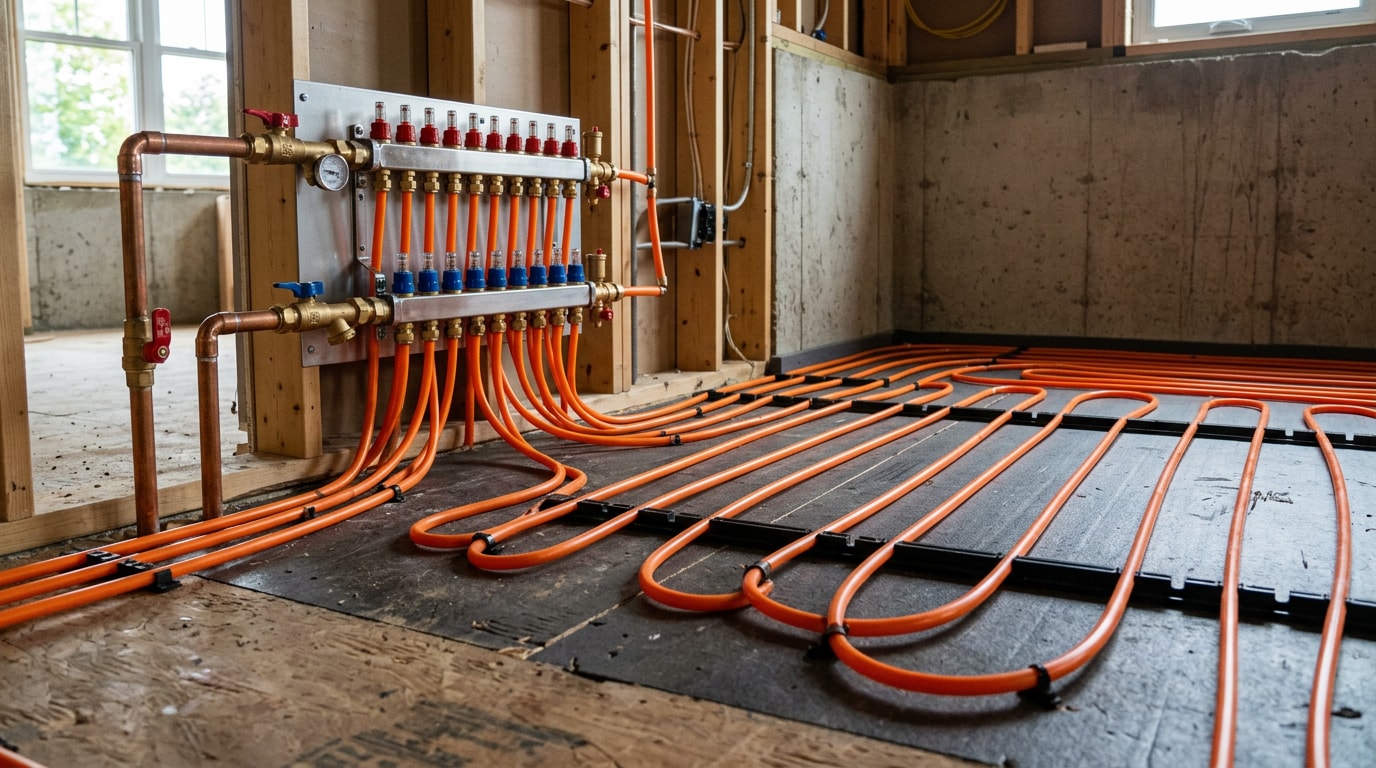
A radiant heating system in Towson, MD warms rowhomes near York Road and new builds in Hampton the same way: from the floor up, with no cold drafts from a vent. If your feet are cold on the tile but the thermostat says the house is warm, something in that hydronic loop or electric mat needs attention. Here's what it actually costs, what breaks, and how to tell a good install from a bad one.
What a Radiant Heating System Costs in Towson, MD
Pricing depends on whether you're running electric cable, hydronic tubing fed by a boiler, or retrofitting one room versus a whole floor.
Electric underfloor heating materials cost $6 to $12 per square foot, and for a typical 50 sq ft powder room, the total installed cost, including an electrician, runs $465 to $900 . A larger primary bathroom runs higher, and a 100 sq ft master bathroom typically lands between $800 and $1,700, with operating costs as low as $14 to $18 per month for a bathroom running four hours a day .
Hydronic systems cost more upfront because you're adding a boiler, a manifold, and a loop of tubing instead of a mat. That extra cost usually pays back over the life of the system: radiant systems avoid the 20-30% energy loss typically found in forced-air ductwork , which is a real operating-cost difference most Towson rowhome owners with leaky basement ductwork never see on paper until they switch.
| Factor | Electric Radiant | Hydronic Radiant |
|---|---|---|
| Typical installed cost | $6-$12/sq ft (materials) | Higher upfront; adds boiler + tubing |
| Best fit | Single rooms, bathroom/kitchen retrofits | Whole-floor or whole-home heating |
| Operating cost | Higher per square foot in large areas | Lower long-term, especially with a condensing boiler |
| Install difficulty in older Towson rowhomes | Easier retrofit under existing tile | May require subfloor or slab work |
If you want a sense of what local labor runs before committing, our HVAC hourly rate breakdown for Parkville, MD covers typical technician rates across Baltimore County, which apply to radiant work too.
Hydronic vs. Electric Radiant Heat: Which Fits Your Towson Home
Electric radiant heat makes sense for a single bathroom, a kitchen remodel, or a basement retrofit where running new boiler piping isn't practical. It's simpler to install and cheaper to add after the fact.
Hydronic radiant heat makes more sense for whole-home heating, especially paired with a boiler in a Towson rowhome that already has hot-water baseboard or steam infrastructure. The upfront investment is bigger, but the comfort and operating cost over 20+ years usually wins out for full-house installs.
We've pulled failed zone valves out of 1950s Towson rowhomes where the original copper manifold was still structurally sound; the valve and thermostat had simply worn out decades before the piping needed any attention. That's typical of hydronic systems: the tubing often outlasts two or three generations of controls.
Signs Your Radiant Heating System Needs Repair
Most radiant floor heating problems trace back to one of a handful of causes:
- Leak in the tubing — a slow pressure drop in the boiler loop, often showing up as a damp spot or unexplained water bill increase.
- Stuck zone valve — one room stays cold while the rest of the house heats normally.
- Failed thermostat — the floor never kicks on, or runs constantly regardless of the setpoint.
- Pressure loss in the boiler loop — the boiler short-cycles or won't maintain temperature.
- Air trapped in the lines — uneven heat, gurgling noises, or cold spots that move around the room.
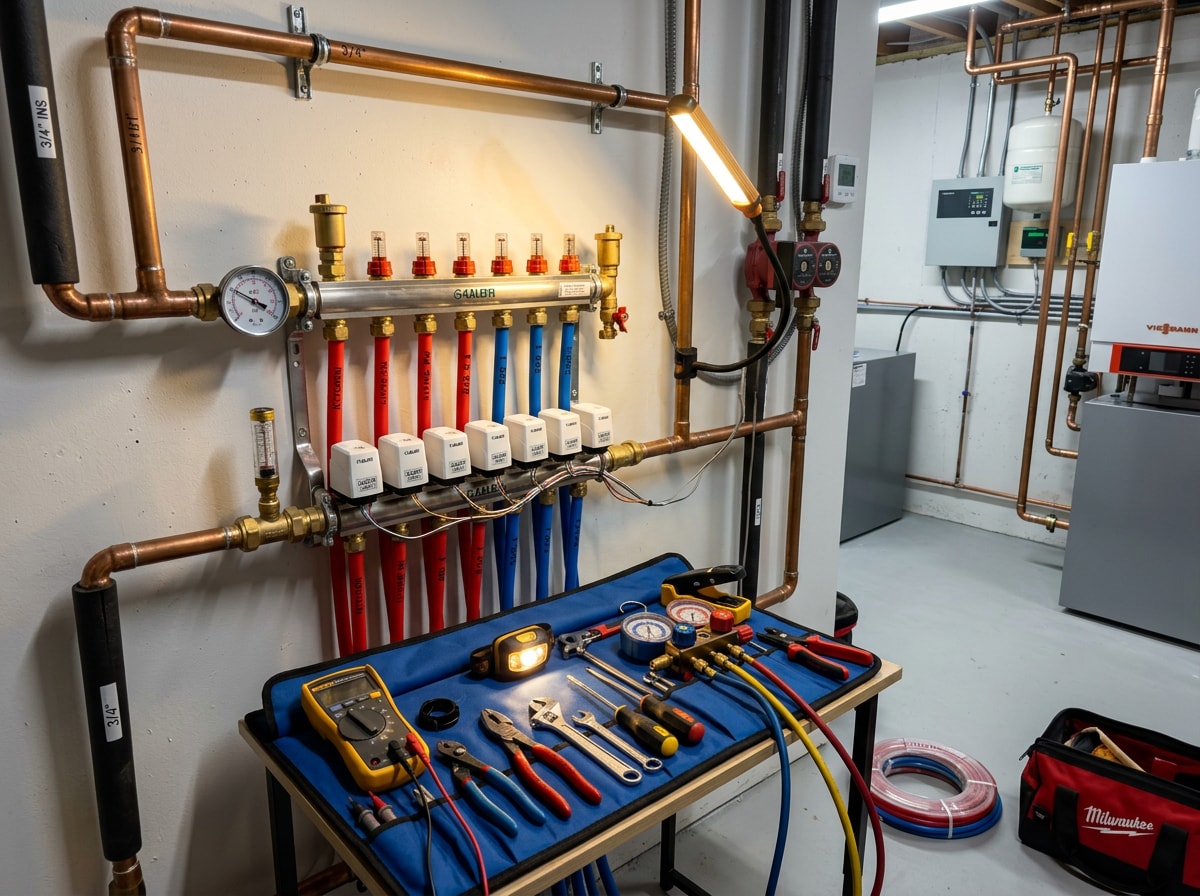
Diagnosing which one you have usually requires pressure-testing the loop and checking zone valve operation, not just guessing from the symptom. If you're seeing any of these, it's worth a furnace repair or heat pump repair technician who also works on hydronic systems rather than a generalist who only touches forced air.
Furnace, Boiler, or Heat Pump: Comparing Whole-Home Heating in Towson
If you're deciding whether to stick with radiant heat or switch systems entirely during a renovation, here's how the three main options stack up for a typical Towson home.
| System | Upfront Cost | Operating Cost | Typical Lifespan | Best Fit |
|---|---|---|---|---|
| Furnace | Lower | Moderate to high | 15-20 years | Homes with existing ductwork, faster installs |
| Boiler (radiant) | Higher | Low to moderate | 20-30 years | Rowhomes, homes wanting even heat with no forced air |
| Heat pump | Moderate | Low in mild winters | 15-20 years | Newer, well-insulated homes; pairs well with hydronic loops |
A boiler feeding a radiant loop is the natural pairing if your priority is even heat and long equipment life. If your Towson home already has a heat pump and you're adding supplemental radiant floor heat in a bathroom or sunroom, that combination works too. Compare options on our HVAC equipment installation and HVAC equipment replacement pages.
Why Radiant Heat Works Well in Towson's Climate
Baltimore County winters run cold and damp more than brutally cold. Towson's January highs typically sit in the low 40s with lows in the mid-to-upper 20s, and humidity stays elevated for weeks at a stretch. That combination makes forced-air heat feel worse than the thermostat reading suggests, because moving dry, blown air across damp skin reads colder than radiant warmth rising from the floor.
Radiant floor heating provides more consistent and comfortable warmth compared to forced-air systems, with heat evenly distributed across the floor, eliminating cold spots and reducing temperature stratification . For Towson's older rowhomes, that also means no new ductwork has to be fought through plaster walls or low basement ceilings.
Older rowhomes near downtown Towson often need a subfloor or slab retrofit to add hydronic tubing, while newer builds in areas like Hampton or Rodgers Forge can integrate tubing directly during construction, which is considerably cheaper than retrofitting. If humidity and air quality are part of what's driving your decision, our indoor air quality assessment can tell you whether your real problem is heat distribution or something else in the house.
Our Radiant Heating Services in Towson, MD
We install and repair both hydronic and electric radiant heat systems for homes throughout Towson, MD and neighboring communities including Timonium, Cockeysville, and Baltimore. That includes:
- Full hydronic radiant heat installation, paired with a new boiler where needed
- Electric radiant mat installation for single-room retrofits
- Zone valve, thermostat, and manifold repair
- Boiler troubleshooting for homes with existing radiant loops
- Routine HVAC maintenance to catch pressure loss before it becomes a cold floor in January
Sizing a radiant system correctly matters more than most homeowners realize. Oversizing wastes money on equipment; undersizing leaves rooms cold no matter how long the loop runs. A proper load calculation, following the ACCA Manual J standard, is the difference between a system that performs for 20 years and one you're troubleshooting every winter. We also offer a home system evaluation if you're not sure whether your existing heating setup is sized correctly before investing in radiant.
Ready to move forward? Get a free estimate and we'll walk your home before quoting anything.
FAQ
Is radiant heat expensive to run?
Electric radiant floor heating can cost as little as $14 to $18 per month to operate in a typical bathroom running four hours a day , which is less than a clothes dryer. Hydronic systems cost more to install but less to run across a whole house, especially when the boiler is high-efficiency.
Is radiant heat worth it for a Towson home?
For most homes here, yes. The upfront cost is higher than a furnace, but you get even heat with no cold spots, no ductwork to maintain, and lower energy loss than forced-air ductwork typically produces . Rowhomes with existing boilers are especially good candidates.
How does a radiant heating system work?
Hydronic systems circulate hot water through tubing under the floor, fed by a boiler. Electric systems run current through cables or mats under the floor surface. Both warm the floor directly, and the floor warms the room, instead of blowing heated air through vents.
Is radiant heat safe?
Yes. Floor surface temperatures stay well below burn thresholds, there's no exposed flame or ductwork to leak carbon monoxide into living space, and boiler-fed systems include safety controls like pressure relief valves and low-water cutoffs.
Can you add radiant heat to an existing floor without major renovation?
Electric radiant mats can often go under new tile or laminate without touching the subfloor structure, which is why bathroom and kitchen retrofits are common. Whole-home hydronic retrofits usually require more invasive subfloor or slab work, which is why new construction or major renovations are the easiest time to add it.
How long does a radiant heating system last?
Hydronic tubing itself can last 30 to 50 years if it's PEX and properly installed. The parts that fail first are the boiler, zone valves, and thermostats, typically every 15 to 25 years, which is why most "radiant heat repairs" are really controls repairs, not tubing replacement.
About the author: This guide was written by the licensed heating technicians at Best Mechanical, who service hydronic and electric radiant heat systems throughout Towson and Baltimore County. Questions about your specific setup? Contact us or visit the Best Mechanical homepage for our full range of heating, plumbing, and inspection services. If you're also dealing with cooling issues, our guide on AC mini splits in Dundalk, MD covers costs for ductless systems that often pair well with radiant heat.